Inspection Performance at a Glance
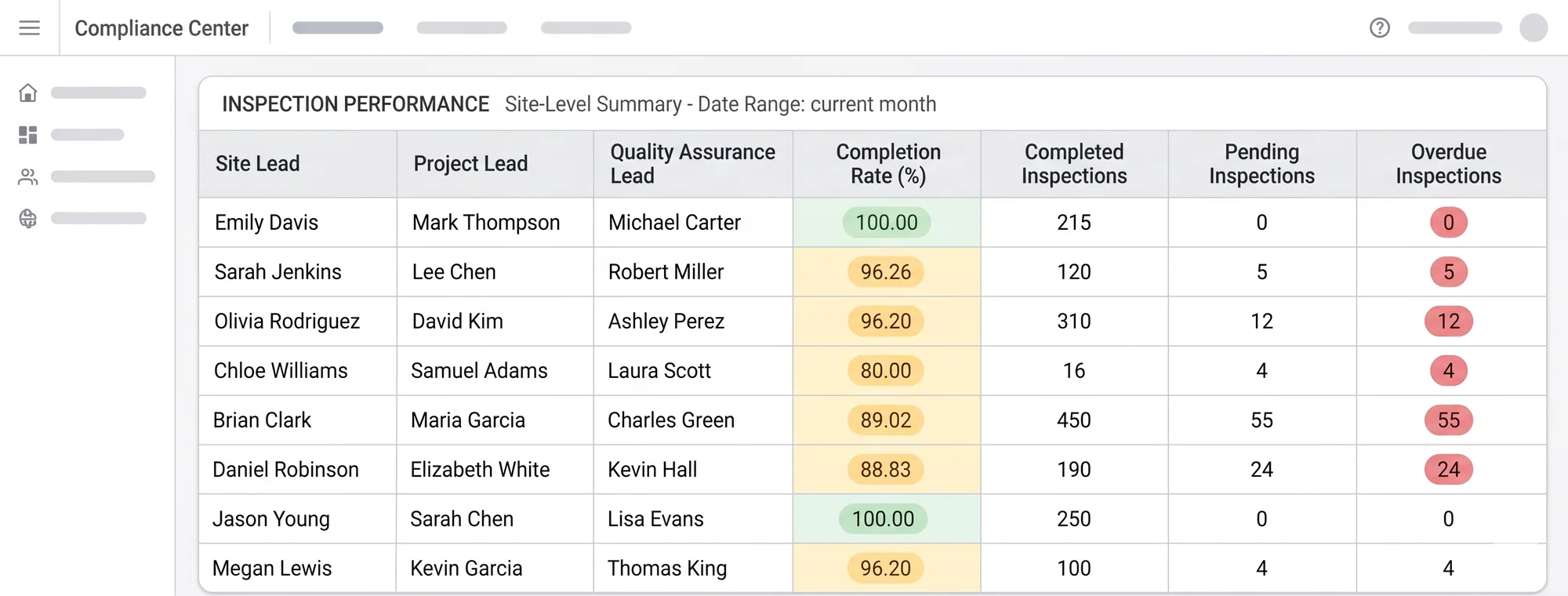
Track completion rates, pending and overdue inspections for every site lead and quality assurance owner in one live view. Screens show sample data.
Inspection management for health, safety and environment equipment: every inspection scheduled, assigned to a qualified inspector, performed on the right form, and followed to repair.
Result: Operational Inefficiency
Result: Proactive Compliance
From equipment setup to a repaired defect, with every inspection on record.
Equipment is grouped by HSE system and equipment type, and each equipment type has its own inspection types.
Each piece of equipment gets a record, its documents, and the inspection form templates it needs. Adding a form creates the first inspection automatically.
Inspections are assigned to inspectors with the right skill level and qualifications, and can be reassigned in bulk when someone leaves or changes roles.
Inspectors complete the form on a PC or tablet. When an inspection is done, the next one is scheduled automatically by its frequency.
Defects that need repair are tracked with the work order number and how they were resolved. Reports show what is overdue, completed, forecast and still open.
HSE system, equipment type and inspection type are set up once, so every inspection lands in the right place and reports line up.
Create and edit forms with tasks, attachments and task order, then map them to equipment. Every inspector uses the same standard form.
The first inspection is created when a form is added to equipment, and each completed inspection creates the next one by its frequency.
Track each inspector's skill level, qualifications and certificates, and assign inspections to the right people.
Move one or many scheduled inspections to a new inspector in a few clicks.
Mark findings that require repair, record the work order notification number, and note who resolved them, when and how.
Scheduled, completed and remaining inspections for the current month or any period you choose.
Performance by system, department and inspector; overdue, scheduled and completed inspections with the completed forms; defect summaries with repair ratio; equipment inventory; forecasted inspections; Excel export.
Keep documents and links with each equipment record. Users sign in with their company account, and admin tools manage users and setup.
Track completion rates, pending and overdue inspections for every site lead and quality assurance owner in one live view. Screens show sample data.
What changes when HSE inspections move into eHSE.
| Feature | Traditional Method | eHSE |
|---|---|---|
| Scheduling | Due dates kept by hand in Excel | Next inspection created automatically by frequency |
| Inspection forms | Paper forms that vary by person | Standard templates mapped to each piece of equipment |
| Inspectors | Qualifications tracked separately | Skill level, qualifications and certificates on record |
| Defects | Repairs lost between inspection and maintenance | Tracked to repair with the work order number |
| Audits | Records gathered by hand | Overdue, completed and forecast reports on demand |
eHSE was built at the request of a plant EHS manager and has been in daily use for years at a U.S. plant of a Fortune 50 manufacturer, alongside eSIRMCA, ePS and ePV Pipe. It is designed to support OSHA compliance and audit readiness.
Plants usually begin with eSIRMCA. When they're ready, they add eHSE Inspections and the other systems below, one at a time, when the fit is right.
Identify efficiency improvements and strengthen compliance and audit readiness across your operation.
Request Your Walkthrough