Real-Time CIL Tracking & Analytics
Gain instant visibility into scheduled tasks, completion rates, and open defects. Empower your management team to monitor plant-wide performance metrics at a single glance.
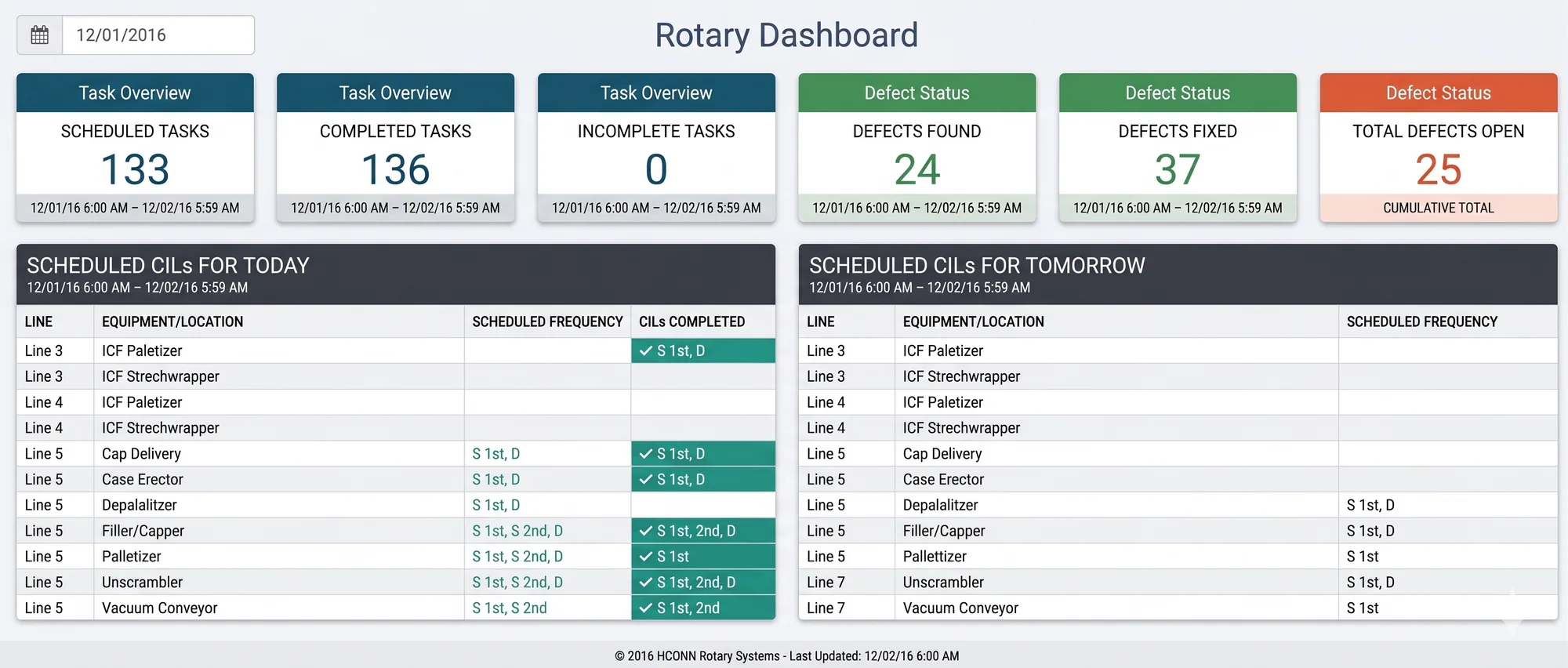
A modernized, computerized CIL Management System that supports 24/7 plant operations. Replace paper-based tasks, single-user Access databases, and Excel-based manual systems with a unified, multi-user online application.
From the CIL standard to a fixed defect, for operators, line leaders and managers on PCs, laptops and tablets.
Each piece of equipment gets its CIL tasks: inspection point, component, standard, one-point lesson, time, frequency, and whether it runs during uptime or planned downtime. Unit diagrams show where each point is.
CILs are scheduled by line, zone and equipment, and the schedule can be reviewed and managed for any date range.
Operators open the CIL on a PC or tablet, see the tasks, the unit diagram and any open defects on that equipment, and record yes/no answers, notes or readings.
Defects found during the CIL are logged on the spot with priority, defect type, photos, an owner, a countermeasure, a due date and a work order number.
Defects are fixed, closed or reopened, and daily, monthly and shift reports show what was found, what was fixed and what is still open.
Templates hold the inspection point, component, standard, one-point lesson, time and frequency for every task, so every operator follows the same standard.
Tasks are marked as run or stop, so the right CILs come up while the line is running and during planned downtime.
Equipment diagrams appear with the CIL, so operators can find each inspection point quickly.
Before logging a new defect, operators see the open defects already recorded for that equipment, which avoids duplicates.
Minor defects, lack of basic conditions, hard-to-reach areas, sources of contamination, quality defect sources, unnecessary items and unsafe conditions, with Immediate, Critical, Important or Deferred priority.
Every defect has an owner, a countermeasure, a due date, a work order number, the person who fixed it and attachments, and it can be reopened if the problem returns.
Defects found in eCIL are managed with eDMS. At plants that run eHSE, ePS or ePV Pipe, inspection defects can be managed in the same list.
Scheduled versus completed CILs by line, zone and equipment; defect summaries by day, month and shift; defects found by operator; plant-wide reports by defect type; Excel export.
Print CIL forms and quick defect reports for line boards and meetings. Users sign in with their company account.
Gain instant visibility into scheduled tasks, completion rates, and open defects. Empower your management team to monitor plant-wide performance metrics at a single glance.
Quantifying the transition to computerized Autonomous Maintenance.
| Capability | Traditional Process | eCIL |
|---|---|---|
| Scheduling & Performance | Paper-based operations & Excel manuals | Automated online scheduling & task history |
| Defect Management | Disconnected processes & lost work orders | Defects logged during the CIL and managed to closure with eDMS |
| Evidence & Context | Text-only descriptions on paper logs | Photos and attachments on every defect, unit diagrams at the machine |
| System Accessibility | Single-user Access DBs at one workstation | Multi-user access via PC, laptop, or tablet |
| Visibility & Reporting | Siloed data requiring manual aggregation | Dashboards and daily, monthly and shift defect reports |
eCIL is in daily use at a U.S. plant of a Fortune 50 manufacturer, supporting continuous 24/7 operations. Abnormalities found during CIL routes go straight into eDMS, so nothing is lost between the operator and the fix.
Plants usually begin with SNMC. When they're ready, they add eCIL and the other systems below, one at a time, when the fit is right.
Move from paper-based operations to a multi-user, real-time computerized system today.
Request Your Demo Today